DFM Meaning: What Design for Manufacturing Actually Is (And Why It Changes Everything)
TL;DR
DFM — Design for Manufacturing — is the discipline of designing a product so it can be built consistently, at scale, with predictable quality and cost. It is not a pre-production checklist. It is an engineering process that should start at the design stage, before tooling is cut or suppliers are locked.
A proper DFM review covers five areas: geometry and process compatibility, tolerance stack-up, part count and assembly complexity, material selection, and assembly sequence. Each one affects cost, yield, and launch risk.
Founders who skip DFM delay problems until they’re expensive. Tooling revisions, T1 failures, and quality drift are almost always the result of decisions that could have been caught earlier.
The rule: the cost of fixing a design problem rises the later it’s discovered. A change in CAD takes hours. A mold revision takes weeks.
What Design for Manufacturing Actually Is
DFM stands for Design for Manufacturing.
It is the discipline of designing a product so it can be made consistently, at scale, with predictable quality and cost.
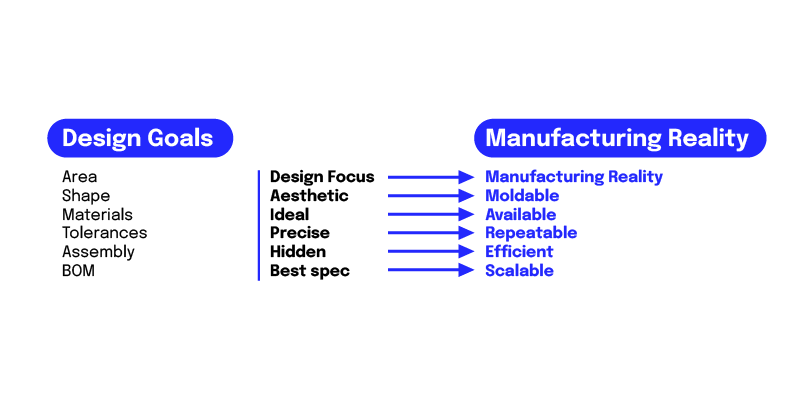
Most founders misunderstand DFM as something you do right before production. That is backwards. DFM should shape your product from the beginning because once tooling is cut or suppliers are locked, many of your most expensive mistakes are already baked in.
For hardware startups, DFM is not a box to check. It is one of the highest-leverage decisions in the entire product lifecycle.
Morpho approaches DFM as a structured engineering process, not a one-time review. We help funded founders building hard goods and electronics test designs early, reduce launch risk, and build products that survive the real world, not just the prototype phase.

What DFM Stands For and Means
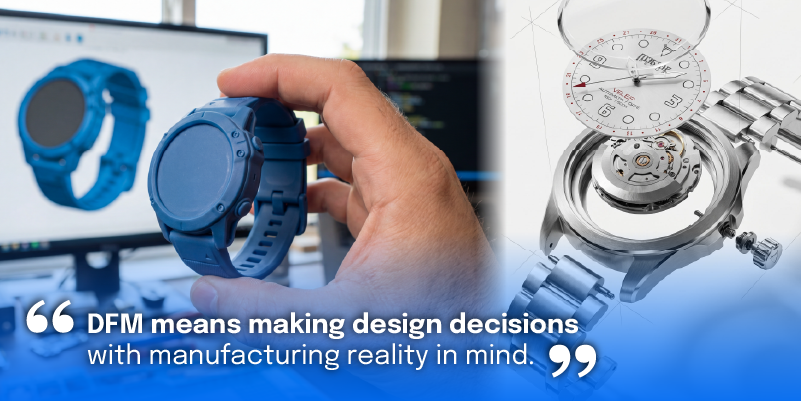
DFM means making design decisions with manufacturing reality in mind.
That includes questions like:
- Can this part be molded or machined reliably?
- Are tolerances realistic at scale?
- Will assembly be repeatable?
- Can we source this material consistently?
- Does this design create avoidable labor cost?
Good DFM makes products easier to build without compromising performance.
Bad DFM creates hidden costs that show up later:
- expensive tooling changes
- low yields
- quality drift
- longer lead times
- warranty failures
DFM is where engineering meets business reality.
What DFM Actually Evaluates
A real DFM review is not generic feedback. It is a detailed engineering process that looks at how your design behaves in production.
1. Geometry and Process Compatibility
Your product must match the realities of the manufacturing process.
For injection molded parts, that means:
- wall thickness consistency
- draft angles
- ribbing and support design
- sink mark prevention
- gate and ejection strategy
For machined parts, it means:
- tool access
- feature complexity
- achievable tolerances
If the process and design are misaligned, cost and failure risk go up fast.
2. Tolerance Stack-Up and Fit
A product can look perfect in CAD and still fail in assembly.
DFM reviews:
- mating interfaces
- tolerance stack-ups
- fastener alignment
- wear points
Small tolerance errors become major problems at scale.
3. Part Count and Assembly Complexity
More parts mean:
- more labor
- more sourcing risk
- more failure points
DFM asks:
- Can this be simplified?
- Can parts be consolidated?
- Can assembly steps be reduced?
This directly affects margins and quality.
4. Material Selection
The best material in theory may be the wrong one in production.
DFM evaluates:
- process compatibility
- durability
- cosmetic finish
- cost stability
- supply chain risk
5. Assembly Sequence and Human Error Risk
Products are built by systems—not CAD files.
DFM reviews:
- assembly order
- fixture needs
- test access
- operator error risk
This is where many startup products fail quietly.
DFM Checklist for Hardware Founders
Use this checklist before tooling or supplier lock-in:
Product Geometry
- Are wall thicknesses consistent?
- Are draft angles built in?
- Are stress points reinforced?
Tolerances
- Have critical fits been stack-analyzed?
- Are tolerances realistic for the process?
- Are cosmetic specs achievable?
Assembly
- Can parts be assembled repeatably?
- Can labor steps be reduced?
- Is serviceability considered?
Materials
- Are materials available and scalable?
- Do finishes create extra failure risk?
- Are substitutions possible if needed?
Supply Chain
- Are long lead components identified?
- Is supplier risk understood?
- Is BOM complexity manageable?
Quality
- Are inspection points clear?
- Is testing built into the design?
- Are likely failure modes known?
This is what a real DFM process should uncover.
What Happens When You Skip DFM
Skipping DFM does not save time. It delays problems until they are expensive.
Common outcomes include:
- tooling revisions after steel is cut
- T1 samples that fail fit or finish
- assembly bottlenecks
- higher scrap rates
- delayed launch timelines
The cost of fixing a design issue rises dramatically the later it is discovered.
A small change in CAD can take hours. A mold revision can take weeks and thousands of dollars.

BullseyeBore Core: DFM in Practice
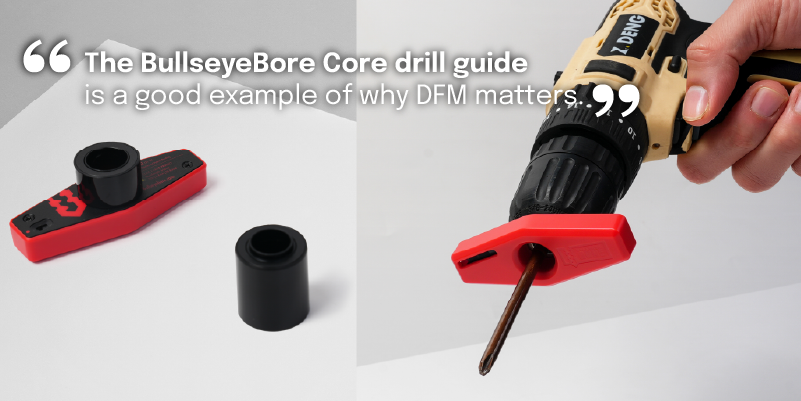
The BullseyeBore Core drill guide is a good example of why DFM matters.
This product required:
- tight tolerances for repeatable alignment
- durable materials for field use
- reliable assembly at scale
It raised more than $1.15 million on Kickstarter—but that launch was built on disciplined manufacturability work long before production.
The reason T1 samples matched production expectations was not luck. It was structured DFM.
This is what Morpho helps founders do: identify risks while they are still cheap to solve.
Morpho’s Approach: DFM as a Process, Not a Meeting
Most DFM consultants treat review as a deliverable.
Morpho treats it as part of the launch system.
Our approach includes:
- engineering review tied to manufacturing process
- BOM and sourcing risk analysis
- supplier capability checks
- prototype learnings fed into design decisions
- assembly and QC planning
We are not a sourcing agent or broker.
We are a manufacturability-first, engineering-led partner that helps founders avoid preventable production failures.
Factories build products. Morpho builds launches.
What is a Discovery Call?
- A free and no-commitment 30-minute session to assess your product, understand Morpho’s process, and map your next steps.
- We’ll validate if your design is manufacturable and compliant.
- You’ll gain guidance on risks, timelines, and our proven premium-build process.
Book a Discovery Call and learn how Morpho can help you move confidently from idea to production.
Final Takeaway
DFM is one of the most misunderstood terms in hardware—and one of the most important.
It is not something you do before manufacturing. It is something you build into the product from the start.
Founders who understand this avoid costly mistakes later. Founders who ignore it usually pay for it in tooling, delays, and quality issues.
If you are building a hard goods or electronics product, a strong DFM process can save months of pain later.
Morpho helps founders make the right decisions while those decisions are still cheap.
FAQ (2026)
What is DFM in manufacturing?
DFM is the process of designing products so they can be manufactured reliably, efficiently, and at scale.
Why is DFM important?
It reduces cost, improves quality, prevents tooling mistakes, and shortens launch timelines.
What does a DFM review include?
A proper DFM review covers geometry, tolerances, materials, assembly sequence, sourcing risk, and quality control considerations.
Author & Last updated
MorphoMFG Engineering Team — Expert, bold, people-first guidance for hardware founders.
- Last updated:
Table of Contents