China Contract Manufacturing: What Happens After You Send Your Files
TL;DR
- Expect a 5–6+ month timeline from files to first production shipment
- The highest-risk moments are file handoff, tooling cut, and pilot runs
- Most factories assemble—they don’t manage DFM, suppliers, or QC systems
- You need component control + on-the-ground oversight to maintain visibility
- The right partner builds the launch system, not just the product
What Happens After You Send Your Files
Do you believe that China contract manufacturing begins the moment your CAD, BOM, and specs hit a factory inbox?
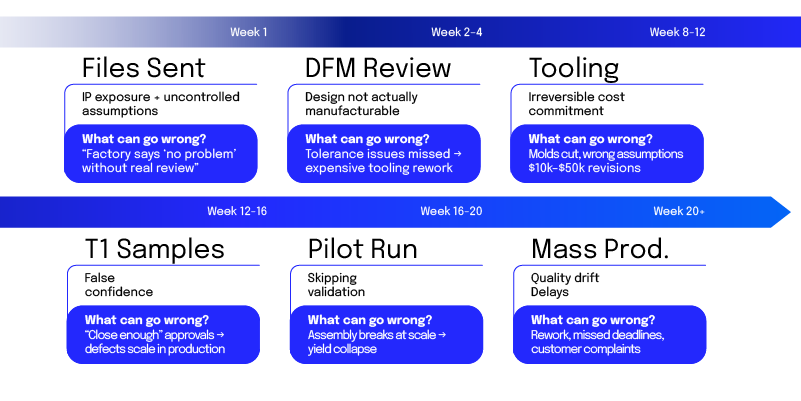
Well, think again. It’s the start of a multi-stage process that typically takes 5–6+ months: DFM review, supplier validation, tooling, T1 samples, pilot runs, and mass production. What happens in each step determines whether your product launches cleanly or fails quietly.
Most founders don’t have a mental model for this timeline. They assume speed. Factories assume you know the process. That gap is where cost overruns, quality issues, and IP exposure happen.
Morpho operates differently. We are a manufacturability-first, engineering-led partner for funded founders building hard goods and electronics. We pressure-test products before cutting steel, control suppliers and components through our Component Control Method (CCM), and manage on-the-ground execution in China so you don’t lose visibility when it matters most.
The Visibility Gap in China Manufacturing
The biggest risk in China contract manufacturing it’s loss of control.
When you send your files, three things happen immediately:
- Your IP leaves your system
- Your BOM enters a new supply chain
- Your design meets real-world manufacturing constraints
If you’re not actively managing those transitions, decisions get made without you.
Factories don’t see this as a problem. They’re optimized to keep lines running. If a component is late, they substitute. If tolerances are tight, they adjust. If assembly is slow, they simplify.
Those decisions may reduce friction for them—but they increase risk for you.
What Actually Happens (Month-by-Month)
- Day 0–7: Files received, initial quoting
- Week 2–4: DFM feedback and revisions
- Month 2–3: Tooling design and fabrication
- Month 3–4: T1 samples (first articles)
- Month 4–5: Pilot run and validation
- Month 5–6+: Mass production and shipment
This is the minimum viable timeline. Complex products (especially electronics) often take longer.
Step 1: DFM Review
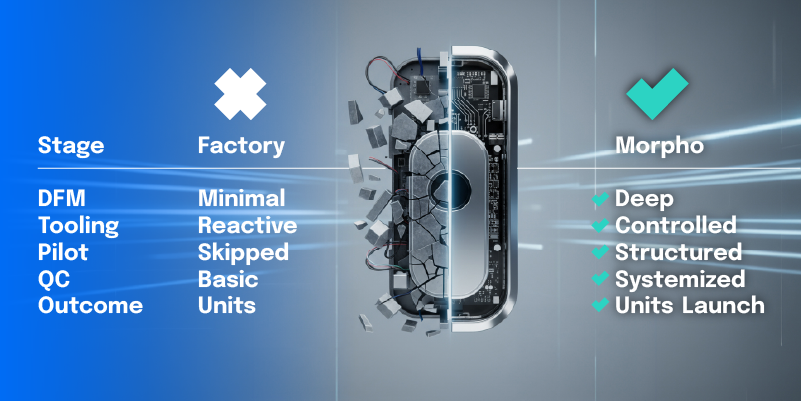
Design for Manufacturing (DFM) is where your product meets reality.
What a strong partner does:
- Reviews tolerance stack-ups and failure modes
- Flags high-risk geometries and materials
- Simplifies assembly without compromising function
- Aligns design with available suppliers
What a factory typically does:
- Reviews only what affects their process
- Misses system-level risks
- Pushes issues downstream
This stage determines whether your tooling will work—or require costly rework.
Step 2: Tooling
Tooling is the first irreversible spend.
Injection molds, dies, fixtures, and jigs define your product’s physical reality.
Key risks:
- Incorrect shrink rates
- Warping and sink marks
- Poor gate placement
- Tool steel quality shortcuts
Strong partner approach:
- Validates DFM before cutting steel
- Selects tooling suppliers intentionally
- Builds in revision strategy
Factory-only approach:
- Cuts tools quickly to hit timelines
- Iterates after problems appear
Step 3: T1 Samples (First Articles)
T1 samples are your first physical validation of the tooling.
This is where most founders realize what they didn’t test.
What to evaluate:
- Dimensional accuracy
- Cosmetic finish
- Fit and assembly
- Functional performance
Common failure pattern:
- Founders approve “close enough” samples
- Issues compound in production
A strong partner treats T1 as a diagnostic stage, not a milestone to rush past.
Step 4: Pilot Run
Pilot production is where you validate repeatability.
Skipping or compressing this stage is one of the most expensive mistakes founders make.
What should be tested:
- Assembly time and workflow
- Yield rates
- QC procedures
- Packaging durability
Factory-only reality:
- Pilot run minimized or skipped
- Problems discovered during mass production
Step 5: Mass Production
Mass production is not the start, it’s the result of everything upstream.
If earlier stages were rushed, production will expose it.
Strong system includes:
- In-line QC
- Final inspection protocols
- Supplier accountability
- Real-time issue escalation
Weak system results in:
- Quality drift
- Rework costs
- Missed delivery windows
Where Projects Go Wrong (and Why)
1. File Handoff (IP Exposure)
Once files are shared, control depends on process, not paperwork.
2. Tooling Commitment (Irreversible Spend)
Cutting steel locks in decisions. Mistakes become expensive.
3. Skipped Pilot Runs
This is where most quality disasters originate.
4. No On-the-Ground Visibility
If you’re not present, you’re relying on reporting—not reality.
Morpho solves this through structured oversight and CCM-driven component control.
Case Study: Écoute Headphones
Integrating a Korg 6P1 vacuum tube amplifier into a production-ready headphone system is not a standard manufacturing challenge.
It requires:
- Thermal management
- Electrical stability
- Component sourcing discipline
- Assembly precision
écoute Headphones demonstrates what happens when complex electronics are managed with full-stack manufacturing control.
This level of complexity cannot be handled by an assembly-only factory.
How to Vet a China Manufacturing Partner
Before committing, founders should evaluate:
- Who controls the BOM and suppliers?
- What DFM process is used before tooling?
- How are QC systems designed and enforced?
- What visibility exists during production?
- Who owns the outcome?
For a deeper breakdown, see Morpho’s guide to selecting the right manufacturing partner in China.
Book a Call With Us
If you need help identifying the right manufacturing partner—or want guidance on validating your prototype, BOM, or supplier list—the next step is scheduling a Discovery Call with Morpho.
What is a Discovery Call?
- A free and no-commitment 30-minute session to assess your product, understand Morpho’s process, and map your next steps.
- We’ll validate if your design is manufacturable and compliant.
- You’ll gain guidance on risks, timelines, and our proven premium-build process.
Book a Discovery Call and learn how Morpho can help you move confidently from idea to production.
Final Takeaway
Mark this: China contract manufacturing is a sequence of decisions.
The founders who succeed are not the ones who move fastest. They are the ones who control the process.
Morpho builds that control into every stage so your product survives beyond the prototype.
If you’re preparing to manufacture in China, the most valuable step you can take is testing your process before production starts.
FAQ (2026)
How long does contract manufacturing in China take?
Typically 5–6 months minimum from files to first production shipment, depending on product complexity.
What should I send to a contract manufacturer?
CAD files, BOM, drawings, specifications, testing requirements, and packaging details.
Is manufacturing in China still reliable in 2026?
Yes—but only with strong process control, supplier management, and on-the-ground oversight.
Author & Last updated
MorphoMFG Engineering Team — Expert, bold, people-first guidance for hardware founders.
- Last updated:
Table of Contents