Selecting the Right Manufacturing Partner in China
TL;DR
- China is the world’s most capable manufacturing base—but not all suppliers are trustworthy.
- Shortlist carefully, verify licenses, avoid middlemen, and confirm real production capacity.
- Factory visits (or local audits) are essential.
- Alibaba is useful for research but risky for final decisions.
- Morpho helps founders choose the right partner through local vetting, IP protection, and factory-specific matching.
Selecting the Right Manufacturing Partner in China
You have painstakingly designed and created a product.
Maybe you’ve even been through the emotional rollercoaster of a crowdfunding campaign, pouring your heart and soul into the Kickstarter or Indiegogo pitch.
Congratulations. First, check the 7 steps to manufacture your product.
Then, it’s gut-check time. Prototyping, manufacturing, planning your cash flows and a hundred other things you didn’t plan out while you were giving the campaign everything you had.
You want to bring this idea to life, and all signs are pointing you toward manufacturing solutions that give you great quality at great prices. At some point, this journey will lead you to manufacturing in China. There is a reason the whole world comes here—the combination of cost, specialization, component availability, and logistics infrastructure is unmatched anywhere else.
But once you get to the details, you realize that making your product in China is trickier than it first seemed. The first and most important step is identifying the right manufacturing partner. This single decision can make or break your entire project, so you must choose wisely.
Step 1: Research and Shortlist
There’s no way around this part. You will need to collect details on as many factories as possible through web directories, industry associations, and word-of-mouth. Start with a shortlist of 10–20 potential partners to focus your efforts.
It helps to filter based on simple criteria:
Geography
Different regions specialize in different products.
For example:
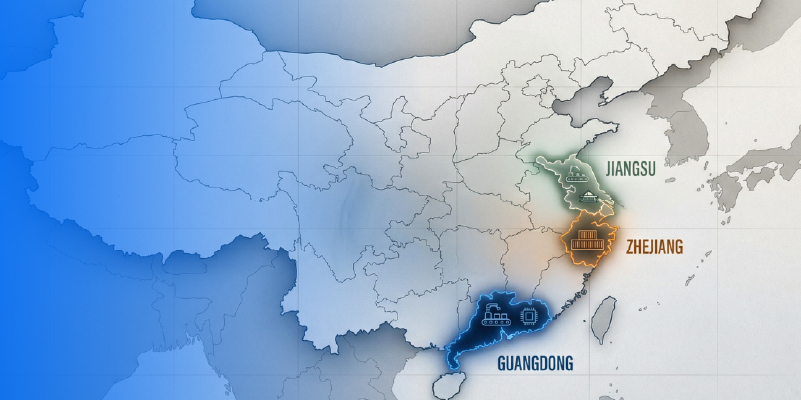
- Guangdong (Shenzhen, Dongguan, Guangzhou): consumer goods, electronics, plastics, PCBA, injection molding
- Zhejiang & Jiangsu: textiles, metal parts, home goods
- Northern provinces: heavy industry, industrial goods, tooling
Proximity to ports, tax zones, and the local supplier ecosystem all influence cost and speed.
Experience
Choose manufacturers with experience in your product category and a proven track record. A factory that has produced similar products will already understand typical issues, common failure points, and compliance requirements.
Step 2: Do Your Due Diligence
This step is critical. China’s manufacturing boom has brought countless reputable suppliers—but also many middlemen and short-term operators. Proper due diligence protects your product, your money, and your IP.
Assume the vendor is a middleman until proven otherwise
Verify whether they own and operate the production facility. If they refuse to disclose the location, you can assume they are a middleman.
Confirm legitimacy and licensing
Ask for:
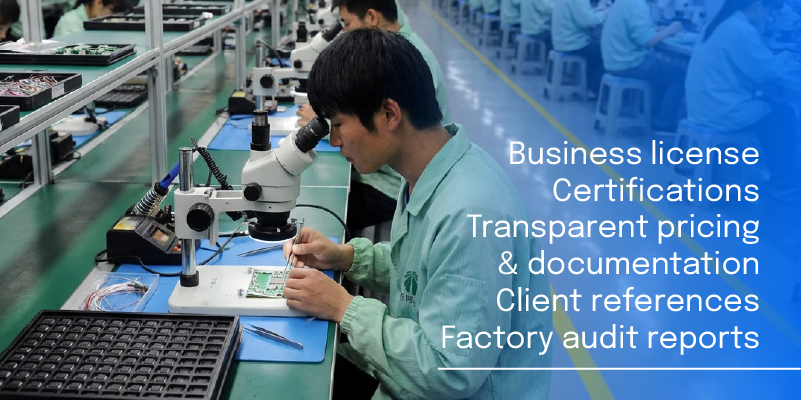
- Business license
- Certifications (ISO, CE, RoHS, UL, depending on product)
- Transparent pricing and documentation
- Client references
- Factory audit reports (if available)
A legitimate supplier will provide these without hesitation.
Check production capacity
You need a manufacturer who can meet your demand, including:
- Ability to scale in case your campaign outperforms
- Reasonable MOQs that won’t trap you with excess inventory
- Stability in lead times and material sourcing
Evaluate communication clarity
Communication issues can cause delays and costly misunderstandings. Note: fluent English does not guarantee a reliable supplier—many middlemen have excellent sales teams while actual factories do not.
Step 3: Visit the Factory in Person (If Possible)
Nothing replaces an in-person visit.
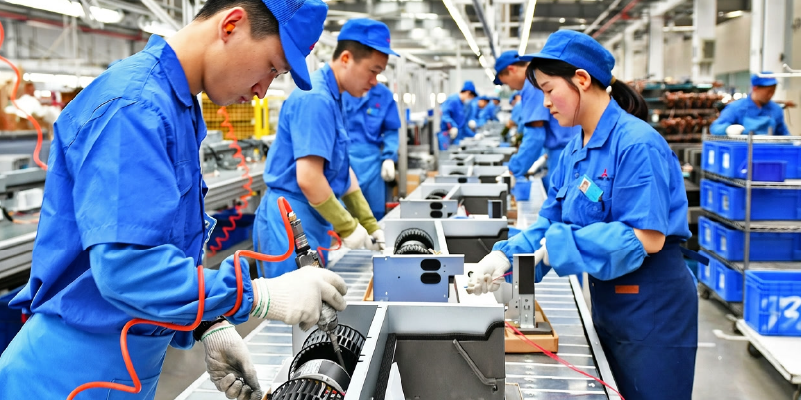
Seeing the factory, equipment, workers, and processes gives you a clear picture of how your product will be made. It also helps establish a real business relationship, which is culturally important in China.
Your visit allows you to:
- Verify equipment and production lines
- Confirm compliance certifications
- Evaluate cleanliness and workflow
- Understand inventory and component management
- Meet management and QC teams
If traveling isn’t possible, hire someone trustworthy who is based in China to perform a factory visit or audit on your behalf.
A Note on Alibaba
Alibaba is a widely used platform for researching manufacturers. It’s useful for basic information like pricing, MOQs, and capabilities.
However:
- Misinformation is common
- Many listings are middlemen rather than real factories
- Photos may not represent the actual facility
- “Gold supplier” status is not a guarantee of legitimacy
When using Alibaba:
- Stick to well-reviewed, verified suppliers
- Never rely on one factory alone
- Protect your IP by splitting component sourcing (do not send the entire design to one vendor)
- Avoid sending full CAD, PCB, or firmware files before a contract is in place
About Morpho

Morpho operates within the manufacturing heart of China, with over 100,000 factories located within a 100-mile radius of our headquarters. Over the years, we’ve built a vetted network of reliable, specialized factories across electronics, plastics, PCBA, metals, textiles, tooling, and more.
This benefits our clients through:
- The ability to match the best factory for each component
- Engineering oversight that ensures manufacturability
- IP protection via the Component Control Method (CCM)
- Avoiding middlemen entirely
- Faster audits and local price benchmarking
- Consistent quality control at every stage
Choosing a manufacturing partner is one of the most important decisions you will make. Having a partner on the ground who understands the language, culture, supply chain, and engineering constraints will dramatically increase your chances of success.
FAQ (2026)
How do I verify that a Chinese manufacturer is not a middleman?
Ask for the factory’s address, business license, and production photos or videos. Real factories will disclose their facilities and capabilities openly. Middlemen typically avoid revealing the actual production site.
What certifications should a legitimate Chinese manufacturer have?
Common certifications include ISO 9001 (quality management), ISO 14001 (environmental management), and industry-specific certificates like CE, RoHS, or FCC depending on your product. Always request documentation and verify authenticity.
Do I need to visit the factory in person?
A visit is highly recommended. It allows you to confirm equipment, staff, workflow, and real production conditions. If traveling isn’t possible, hire a trusted partner or local team (like Morpho) to conduct a factory audit and validate everything on your behalf.
How do I assess whether a factory can scale with my production needs?
Review their MOQ, production line capacity, lead times, and past experience with similar-scale projects. A good manufacturer can ramp up quickly after your product gains traction, without increasing costs or compromising quality.
Is Alibaba a reliable way to find manufacturers?
Alibaba is useful for initial research, pricing benchmarks, and MOQ comparisons—but many listings belong to trading companies, not real factories. Always verify ownership, request documentation, and avoid sending complete design files before trust is established.
Why should I consider working with a partner like Morpho instead of going directly to factories?
Morpho operates within China’s core manufacturing ecosystem, with access to vetted factories in specific niches. We perform due diligence, protect your IP using the Component Control Method (CCM), match you with the right supplier, and manage quality and communication throughout the project.
Book a Discovery Call
If you need help identifying the right manufacturing partner—or want guidance on validating your prototype, BOM, or supplier list—the next step is scheduling a Discovery Call with Morpho.
What is a Discovery Call?
- A free and no-commitment 30-minute session to assess your product, understand Morpho’s process, and map your next steps.
- We’ll validate if your design is manufacturable and compliant.
- You’ll gain guidance on risks, timelines, and our proven premium-build process.
Book a Discovery Call and learn how Morpho can help you move confidently from idea to production.
Author & Last updated
MorphoMFG Engineering Team — Expert, bold, people-first guidance for hardware founders.
- Last updated:
Table of Contents